TL;DR: Microsoft ended Windows 10 support on October 14, 2025. An estimated 240 million PCs can’t meet Windows 11’s hardware requirements, and analysts project 320–350 million laptops will move through refresh cycles by 2028 — one of the largest synchronized hardware turnovers in IT history. For enterprise IT and finance teams, that means a compliance deadline, a budget decision, and an IT asset disposition problem arriving at the same time.
Why are so many PCs being retired at once?
Windows 10 reached end of support on October 14, 2025, meaning Microsoft stopped issuing free security updates for the OS. Windows 11 has stricter hardware requirements (TPM 2.0, specific CPU generations) that a large share of the installed base doesn’t meet — estimates put that number at roughly 240 million devices globally. Because most organizations bought their current PC fleets in similar windows during the past several years, this isn’t a trickle of individual replacements; it’s a synchronized wave, with an estimated 320 to 350 million laptops expected to move through refresh cycles between late 2026 and 2028.
What does that mean in terms of actual e-waste?
By one estimate, the transition could generate roughly 1.06 billion pounds (480 million kg) of electronic waste if organizations default to disposal rather than remarketing or refurbishment. Improperly managed e-waste isn’t just an environmental line item, either — UN research cited by industry analysts puts the externalized global cost of poor e-waste handling at roughly $78 billion a year in human health and environmental impact.
Is it cheaper to pay for extended support or just replace the fleet?
For many organizations, migration wins on cost even before you factor in compliance risk. Microsoft’s Extended Security Updates (ESU) program is priced to escalate: roughly $61 per device in year one, $122 in year two, and $244 in year three — about $427,000 for a 1,000-device fleet over three years. A one-time migration to new, Windows 11–compatible hardware typically runs $800–$1,200 per device, and unlike ESU, it’s a capital investment rather than a recurring compliance tax on aging hardware that’s also losing resale value the longer you hold onto it.
What’s the compliance risk if we get disposal wrong?
Retiring a PC fleet isn’t just a hardware decision — it’s a data security event. Devices that shipped out without certified data destruction, or that sat in storage without documented chain of custody, create exposure under state privacy laws and sector-specific regulations. Healthcare organizations face this acutely: average HIPAA penalties for improper device disposal run around $98,000, with the highest violations reaching $6.8 million. On top of that, the Corporate Sustainability Reporting Directive (CSRD) now requires large companies to report FY2025 ESG data in 2026, which puts documented, auditable IT asset disposition on the same radar as financial reporting.
What should IT teams do with retired Windows 10 fleets?
- Separate “retire” from “replace” decisions. Not every device that can’t run Windows 11 is worthless — plenty of it still has resale or component value on the secondary market.
- Get certified data destruction before resale, not instead of it. A device can be both wiped to a verifiable standard and remarketed for recovered value; those aren’t mutually exclusive.
- Get serialized certificates of destruction for every device, not a single batch certificate for the whole fleet. Auditors and regulators increasingly expect device-level documentation.
- Move before the refresh backs up. With hundreds of millions of devices hitting the secondary market over the same two-to-three-year window, resale value on retired laptops will likely soften as supply increases. Earlier movers generally recover more.
How does this connect to your ITAD program?
This refresh wave is landing on top of tightening e-waste and data privacy regulation, which means the stakes for getting disposal wrong are higher than in past refresh cycles — but so is the opportunity to recover real value from equipment that still has a second life. Organizations that plan their fleet retirement as an asset recovery event, rather than a disposal problem, typically come out ahead on both the compliance side and the balance sheet.
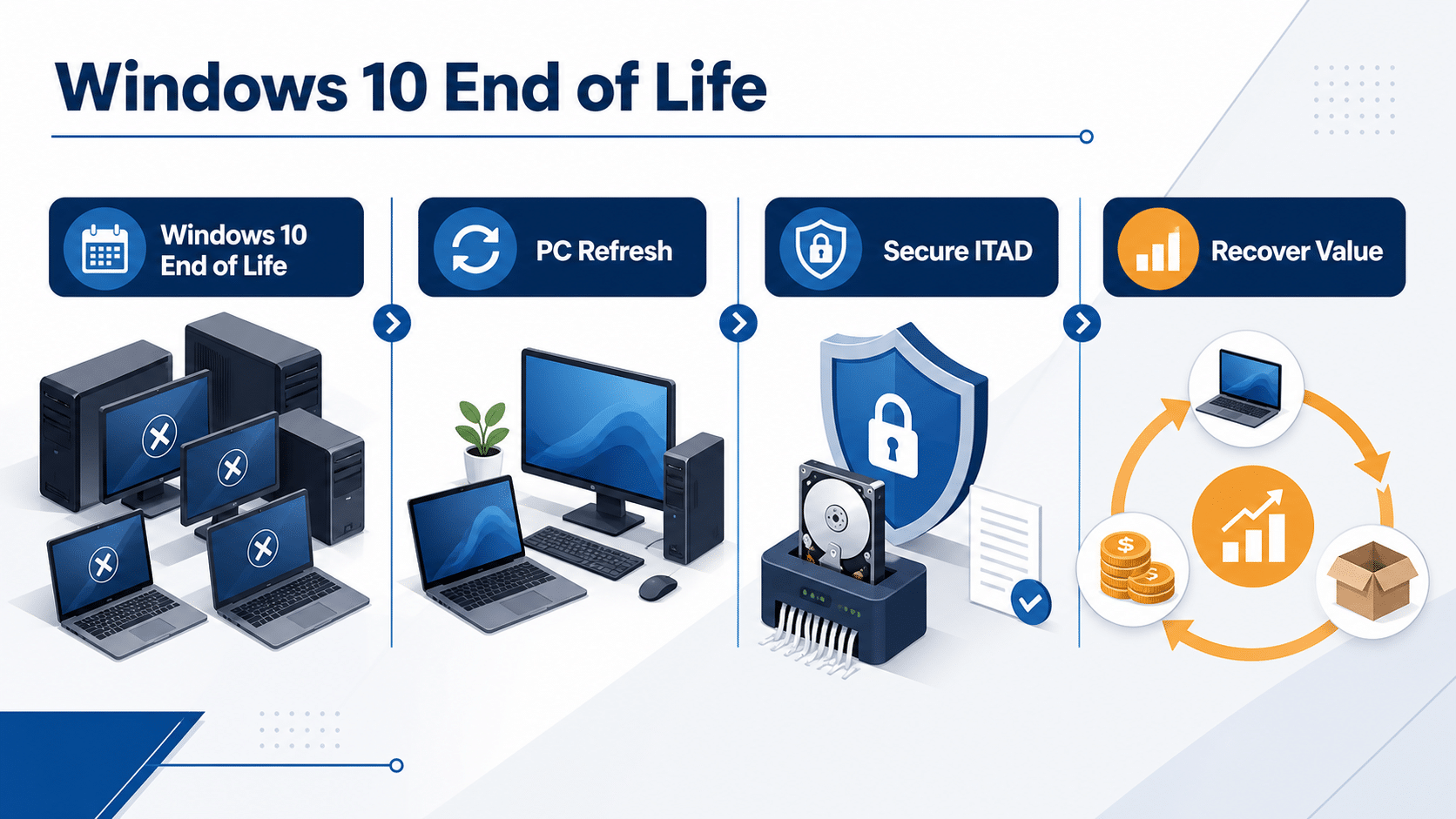
That’s the exact gap StarPC Excess fills. We inspect, value, and pick up retired PCs, laptops, and the servers and infrastructure behind them, issue serialized certificates of data destruction for every device, and pay upfront with free pickup — turning a Windows 10 refresh from a compliance headache into recovered budget.
FAQ
When did Windows 10 support actually end?
Microsoft ended free security updates for Windows 10 on October 14, 2025. Devices still running it are no longer receiving security patches unless enrolled in Extended Security Updates (ESU).
How many PCs are affected by the Windows 10 refresh cycle?
Estimates put the number of devices that can’t meet Windows 11’s hardware requirements at around 240 million globally, with 320–350 million laptops expected to move through refresh cycles between late 2026 and 2028.
Is it better to pay for Extended Security Updates or replace the hardware?
For most fleets, replacement is cheaper over a 2–3 year horizon. ESU pricing escalates annually (roughly $61/$122/$244 per device across three years), while migration to compatible hardware is typically a one-time $800–$1,200 per-device cost — and unlike ESU, retired hardware can be resold to offset that cost.
What happens if a company disposes of retired PCs without certified data destruction?
It creates direct compliance exposure. Depending on the sector, that can mean state privacy law violations, HIPAA penalties (averaging around $98,000, with the highest cases reaching $6.8 million), and reputational risk from a potential data breach traced back to improperly wiped equipment.
Can retired Windows 10 PCs still have resale value?
Often, yes. A device that can’t run Windows 11 can still have functioning components — or run Windows 11 with an upgrade, or serve non-Windows use cases — that carry resale value on the secondary market, provided it’s properly evaluated rather than defaulted to recycling.