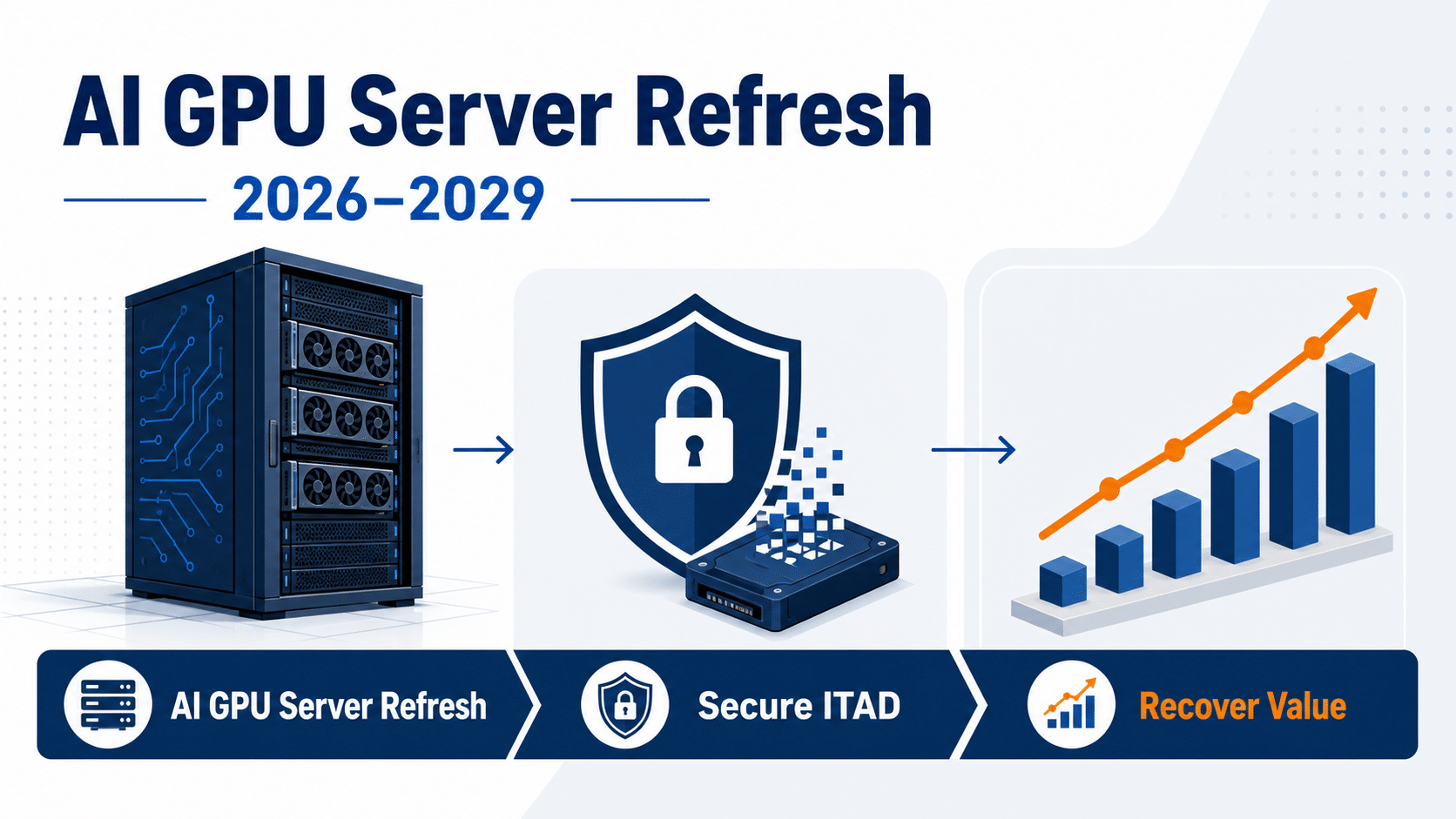
TL;DR: The GPU-dense servers that powered the 2022–2024 AI buildout are now entering their first refresh cycle. Analysts expect a rolling wave of AI hardware retirements between 2026 and 2029, and unlike past server refreshes, this equipment carries far more recoverable value per rack — and far more risk if it’s mishandled. Organizations that treat this as a routine trade-in cycle instead of a specialized ITAD event are leaving money on the table and exposing themselves to data security and compliance risk.
Why is so much AI server hardware being decommissioned right now?
Hyperscalers and enterprises deployed GPU-dense AI infrastructure aggressively between 2022 and 2024 to meet demand for generative AI workloads. Most of that hardware runs on a 3-to-5-year refresh cycle, which means the earliest deployments are now aging out. Industry recyclers describe this as “a rolling, staggered series of retirements” rather than a single event, with volumes climbing steadily through 2029 as successive deployment waves reach end of life.
This isn’t a typical server refresh. AI infrastructure clusters GPUs, high-capacity memory, and specialized cooling and networking gear at a density the ITAD industry hasn’t processed before, which changes both the economics and the handling requirements of decommissioning.
What makes AI hardware different from a standard server refresh?
Three things separate this wave from previous data center refresh cycles:
- Concentrated value per rack. A single rack of GPU-dense servers can carry components worth many times more than a comparable general-purpose compute rack from five years ago. Component harvesting — recovering GPUs, memory, and storage individually rather than processing equipment as scrap — is now the default approach among specialized recyclers, because shredding this hardware destroys value that’s genuinely recoverable.
- Technical complexity. GPU servers, custom cooling systems, and high-density interconnects require more specialized handling, testing, and grading than legacy rack servers. Recyclers are investing in machine vision and AI-enabled classification tools specifically to keep pace with the volume and variety of components coming off these racks.
- Documentation demands. Cloud operators and enterprises reporting on ESG and carbon commitments need detailed chain-of-custody and lifecycle documentation for retired AI infrastructure — not just a certificate that says the equipment was recycled somewhere.
What should IT and finance teams do differently?
- Don’t default to bulk disposal. GPU-dense servers should be evaluated component by component. A blanket “recycle everything” decision on this hardware likely means giving away significant recoverable value.
- Insist on data-secure disassembly, not just data wiping. Enterprise GPU and storage components can carry sensitive workload data. Sanitization needs to happen before components are separated, tested, and remarketed — not as an afterthought.
- Get serialized documentation for every asset class, not just a blanket certificate for the whole lot. Auditors, insurers, and ESG reporting frameworks increasingly expect asset-level detail.
- Time your evaluation before the refresh, not after. Recoverable value on GPU hardware tends to decline the longer equipment sits idle post-decommissioning, both because of technical depreciation and because buyers of secondary-market components have their own refresh cycles to plan around.
How does this connect to your broader ITAD strategy?
This wave is arriving at the same time e-waste regulation is tightening. Extended Producer Responsibility laws are expanding at the state level, and global e-waste is projected to reach 82 million metric tonnes by 2030 — with less than a quarter of it properly recycled today. Regulators and auditors are paying closer attention to how retired IT infrastructure is documented and disposed of, which means the informal “call a recycler when the rack is full” approach carries more compliance exposure than it used to, on top of the lost recovery value.
For organizations retiring servers, storage, memory, or processors as part of an AI infrastructure refresh, the practical takeaway is the same one that applies to any high-value IT asset disposition: get an itemized valuation before you commit to a vendor, confirm data destruction happens before resale or component separation, and get serialized certificates for what was destroyed and what was remarketed.
This is exactly the kind of decommissioning event StarPC Excess was built for. We evaluate servers, GPUs, memory, processors, storage, and networking equipment individually rather than by the pallet, issue certificates of data destruction for every asset, and pay upfront with free pickup — so the AI hardware coming off your racks turns into recovered value instead of a line-item write-off.
FAQ
Is it worth decommissioning AI/GPU servers through a specialized ITAD vendor instead of a general recycler?
Yes, in most cases. GPU-dense hardware carries concentrated, recoverable component value that a general scrap-focused recycler isn’t set up to evaluate or remarket. A specialized ITAD partner assesses components individually, which typically recovers significantly more value than bulk recycling.
Does decommissioned AI server hardware need special data destruction handling?
Yes. GPUs, high-capacity memory, and storage in AI infrastructure can retain sensitive workload data. Sanitization should happen before any component is separated, tested, or remarketed, with a serialized certificate of destruction for each asset — not a single blanket certificate for a batch.
When should we start planning for our AI server refresh?
Before the equipment is fully retired. Recoverable value on GPU-dense hardware tends to decline the longer it sits idle post-decommissioning, so getting an itemized valuation while planning the refresh — rather than after the racks are already offline — generally produces a better return.
What’s the difference between recycling and remarketing retired IT assets?
Recycling breaks equipment down for material recovery (metals, plastics), which typically returns little to no value to the original owner. Remarketing tests, grades, and resells functioning components or whole units on the secondary market, which is where most of the recoverable value in a GPU-dense refresh actually lives.