TL;DR: The newest generation of data center processors, shipping in the second half of 2026, packs up to 256 cores per socket and delivers roughly 70% more performance than the generation before it. That enables server consolidation ratios of 10:1 or more against systems bought around 2019–2021, which means millions of older servers are about to be retired. Organizations that plan the exit of that hardware — selling it while demand for used equipment is strong and handling data destruction properly — can turn a refresh project’s biggest liability into a meaningful source of funding.
What changed in server processors in 2026?
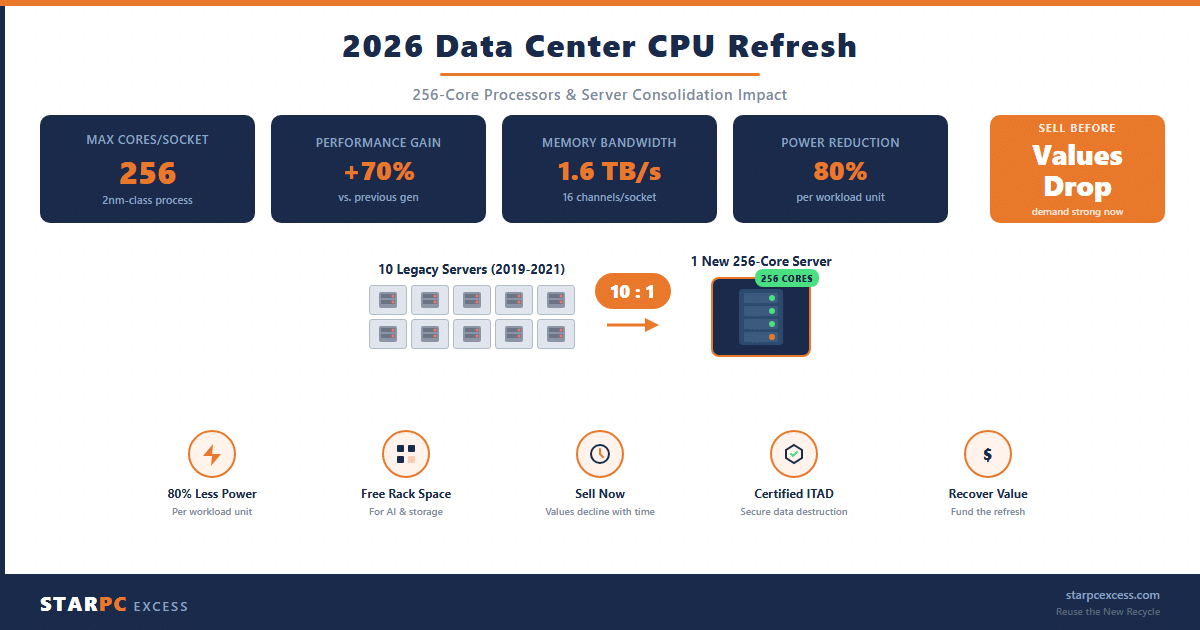
Server processors took one of their biggest generational leaps in years. The flagship 2026 designs are built on a 2nm-class manufacturing process, scale to 256 cores per chip, and deliver about 1.6 TB/s of memory bandwidth per socket across 16 memory channels. Compared with the previous generation, they offer roughly 1.3x the thread density and 1.7x the performance.
Just as important, CPUs are back at the center of data center planning. After three years in which GPU spending dominated budgets, AI workloads have created new demand for general-purpose compute: agentic AI systems that call tools and query databases, reinforcement learning pipelines that compile and verify code, and the large data-processing clusters that feed GPU farms. Datacenter CPU spending is projected to grow at strong double-digit rates in 2026, and server-class chips are once again supply-constrained.
Why does a faster CPU mean so many servers get retired?
Because one new server can now do the work of many old ones. Consolidation ratios of 10:1 or greater are achievable when replacing servers from the 2019–2021 buying cycle — including the millions of machines purchased during the pandemic-era cloud buildout. The new systems match the old ones’ output at less than one-fifth of the power.
For an IT or facilities team, the math is compelling:
- Power and cooling: Replacing ten legacy servers with one or two modern systems can free up significant rack power — often the scarcest resource in a data center today.
- Floor space: Consolidation releases racks that can be reassigned to AI or storage workloads.
- Licensing: Fewer sockets and hosts can lower per-host software and support costs.
- Maintenance: Aging servers are coming off warranty, and extended support contracts get more expensive each year.
Which servers are most likely to be decommissioned?
The servers most likely to be retired in the current cycle are dual-socket systems roughly four to seven years old. That typically includes platforms based on second- and third-generation Xeon Scalable processors and first- through third-generation EPYC processors, along with the storage arrays and networking gear deployed alongside them.
These systems are not worthless — far from it. They remain fully capable for many workloads, which is exactly why there is an active secondary market for them among businesses, labs, hosting providers, and resellers that need affordable compute.
Is there still demand for older servers in 2026?
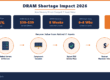
Yes, and in some ways demand is stronger than usual. New server prices have climbed sharply because of the memory and storage shortage, and lead times from major manufacturers have stretched to 6–8 weeks for standard configurations and 20 weeks or more for custom builds. Buyers who cannot absorb those costs or wait that long are turning to used equipment.
That creates an unusual window: the same refresh cycle that is pushing older servers out of enterprise data centers is also creating buyers for them. The components inside — especially memory, processors, and SSDs — carry real value on their own.
What is the biggest mistake companies make when retiring servers?
The biggest mistake is treating decommissioning as an afterthought. Refresh projects are usually planned around the new hardware: procurement, deployment, migration. The old hardware gets pushed to a storage room, a loading dock, or a recycling bin — and its value quietly erodes.
Common, costly patterns include:
- Letting equipment sit. Used server values decline steadily; a system worth a meaningful sum today may be worth a fraction of that in 18 months.
- Recycling by weight. Paying or being paid by the pound ignores the value of CPUs, RAM, and drives.
- Separating data destruction from resale. Shredding every drive by default, or using a vendor that offers destruction but no buyback, forfeits value in flash storage and complicates the audit trail.
- Not getting itemized pricing. A single lump-sum offer makes it impossible to know whether high-value components were priced fairly.
How should IT teams plan the exit of old hardware?
The most effective approach is to build asset disposition into the refresh plan from day one:
- Inventory early. Record models, CPU generations, memory configurations, and drive counts before systems are unracked.
- Stage the exit with the migration. Schedule pickups to follow each migration wave instead of waiting for the whole project to finish.
- Require an itemized valuation so every component is accounted for.
- Insist on certified data sanitization with documentation for every data-bearing device.
- Apply the proceeds to the refresh budget to lower the net cost of the new hardware.
Turning the 2026 server refresh into a return
A generational CPU leap is good news for performance, power budgets, and data center density. But the financial outcome of a refresh depends on both sides of the ledger — what you spend on new systems and what you recover from the old ones.
StarPC Excess has helped organizations recover value from retired enterprise IT equipment since 2004. Based in the Bay Area, StarPC Excess buys decommissioned servers, storage, networking equipment, processors, memory, and hard drives, and provides an itemized valuation so every component — from CPUs to high-capacity RAM — is priced on its own merits. Once you accept the offer, you receive upfront payment and free pickup, and every data-bearing device goes through complete data sanitization with certificates of destruction for your compliance records. For teams consolidating ten old servers into one new one, StarPC Excess turns the nine you no longer need into capital for what comes next.
Frequently Asked Questions
What is a server consolidation ratio?
A server consolidation ratio is the number of older servers a single new server can replace while delivering the same performance. With 2026-generation processors of up to 256 cores, ratios of 10:1 or higher are achievable against servers from the 2019–2021 buying cycle.
Should I sell my old servers after a data center refresh?
Yes, in most cases. Retired servers lose value the longer they sit, and demand for used enterprise hardware is currently strong because new server prices and lead times have risen sharply. Selling promptly, with certified data destruction, recovers the most value.
Are 5-year-old servers worth anything?
Yes. Servers four to seven years old remain capable for many workloads and have an active resale market. Their processors, memory, and drives also have component-level value, particularly while memory prices remain elevated in 2026.
How do I make sure data is destroyed when I sell servers?
Work with a buyer that performs complete data sanitization on every drive and SSD and provides certificates of destruction. That documentation gives your security and compliance teams a verifiable audit trail.
Who buys decommissioned servers in bulk?
StarPC Excess, based in the Bay Area since 2004, buys decommissioned servers, storage, networking gear, processors, memory, and drives in any quantity. It provides itemized offers, upfront payment, free pickup, and certified data destruction.