TL;DR: Yes. The 2026 memory shortage has pushed DRAM prices to record highs — DDR4 chip spot prices are up roughly 276% since November 2025, and server DDR5 now sells for about $30–$39 per gigabyte. That means the RAM, SSDs, and complete servers sitting in your decommissioning queue carry far more recoverable value than they did a year ago. Organizations that sell retired hardware now, through a buyer that values it component by component, can recover significantly more than those that recycle it by the pound or let it sit.
Why are memory prices so high in 2026?
Memory prices are high because AI data centers are consuming wafer capacity faster than chipmakers can add it. Manufacturers have shifted production toward high-bandwidth memory (HBM) for AI accelerators, and each unit of HBM consumes roughly three times the wafer capacity of standard DDR5. HBM supply is sold out for 2026 under multi-year agreements, which leaves less capacity for the conventional DDR4 and DDR5 that ordinary servers use.
The result has been one of the sharpest price spikes the memory market has ever seen:
- DRAM contract prices rose 93–98% quarter over quarter in Q1 2026, with further increases of 13–18% projected for Q3.
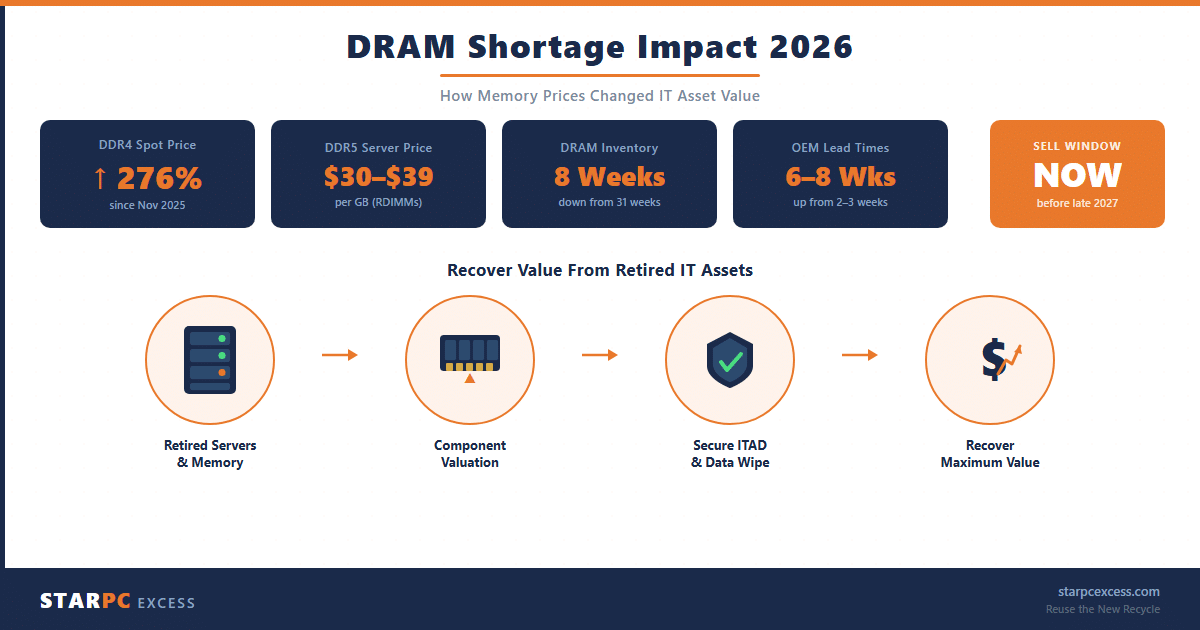
- DDR4 1Gx8 chip spot prices hit about $45.79 in mid-September 2026, up from roughly $12 in November 2025.
- DDR5 prices are up 3.5x to 4x on many product variants; a 32GB consumer DDR5 kit now retails for $425–$560.
- Server DDR5 RDIMMs cost roughly $30–$39 per gigabyte, putting a 512GB dual-socket memory configuration above $20,000.
- DRAM inventory fell to about 8 weeks of supply in late 2025, down from 31 weeks in early 2023.
How long will the memory shortage last?
Most industry forecasts show no meaningful price relief before late 2027, and some extend the tight market into 2028. New fab capacity takes years to come online, and AI demand shows no sign of slowing. For IT teams planning decommissioning schedules, that means the current high-value window is real but finite — once new supply arrives, secondary-market prices will fall with it.
What does the shortage mean for new server purchases?
It means new servers cost far more and take longer to arrive. Memory and storage alone can now push a single well-configured server to around $40,000 before CPUs are added, with enterprise NVMe drives running $325–$631 per terabyte. Lead times from major OEMs have stretched from 2–3 weeks to 6–8 weeks, and custom configurations can take 20–26 weeks or longer.
That pressure is sending buyers to the secondary market. Businesses that cannot wait months or absorb the price increase are actively looking for used and refurbished RAM, drives, and complete systems — which is exactly what most organizations have sitting in storage rooms and decommissioning cages.
Which retired IT assets have gained the most value?
The assets with the biggest value gains are the ones that contain memory and flash storage. In practical terms:
- Server RAM (DDR4 and DDR5 RDIMMs/LRDIMMs). DDR4 is still about 56% cheaper per gigabyte than DDR5, which makes it highly attractive to buyers extending the life of existing platforms. High-capacity modules (32GB, 64GB, 128GB) are especially sought after.
- Enterprise SSDs and NVMe drives. NAND pricing has followed DRAM upward, lifting the resale value of data center flash — provided it is properly sanitized.
- Complete servers with populated memory. A retired server with 256GB–1TB of RAM is now worth far more as a unit, or when parted out, than the same machine was in 2024.
- Workstations and high-memory desktops. Machines with 64GB+ of memory are in demand from buyers who cannot justify new-build prices.
Is it better to keep old servers running or sell them now?
For most organizations, selling surplus hardware now is the better financial decision — but the answer depends on what is truly surplus. If a server is still in production and meeting its workload, extending its life can be a sensible hedge against expensive replacements. But equipment that is already retired, powered off, or waiting for a “someday” project is a depreciating asset in a temporarily inflated market. Every quarter it sits, its value is exposed to the eventual price correction.
A practical approach many IT teams are taking:
- Harvest memory internally first where it can extend the life of production systems.
- Sell everything else while prices are elevated, especially DDR4 platforms and high-capacity modules.
- Use the proceeds to offset new purchases, which reduces the net cost of refresh projects during a period of record hardware pricing.
Why the way you dispose of hardware matters more than ever
The memory shortage exposes a costly gap between how many organizations handle retired equipment and what that equipment is actually worth. Recycling programs that pay by weight, or charge a disposal fee, treat a server loaded with 768GB of DDR4 the same as a pallet of scrap metal. In today’s market, that can mean leaving thousands of dollars per server on the table.
At the same time, the stakes around data security have not changed. Every drive and SSD leaving your facility must be sanitized to a verifiable standard, with documentation that stands up to an audit. Selling hardware for value and meeting compliance obligations are not competing goals — but they require a partner that does both.
This is where StarPC Excess fits. Operating in the Bay Area since 2004, StarPC Excess buys surplus and decommissioned enterprise IT equipment — servers, storage, networking gear, processors, memory, and hard drives — and prices it at the component level, so high-value RAM and flash storage are valued for what they are actually worth in the current market. The process is simple: submit your equipment list, receive an itemized offer, and get upfront payment with free pickup. Every data-bearing device is handled with complete data sanitization and certificates of destruction, giving your security and compliance teams the documentation they need. In a market where memory has become one of the most valuable components in the data center, StarPC Excess helps you turn retired assets into real return instead of disposal costs.
Frequently Asked Questions
How much is used server RAM worth in 2026?
Used server RAM is worth substantially more in 2026 than in previous years because new DRAM prices have more than tripled since late 2025. New server DDR5 sells for roughly $30–$39 per gigabyte, and DDR4 chip spot prices are up about 276%. Actual resale value depends on module type, capacity, speed, and condition, so an itemized quote is the most reliable way to know what your inventory is worth.
Should I sell old DDR4 servers now or wait?
For equipment that is already retired, selling now is usually the stronger choice. Forecasts show memory prices staying elevated until late 2027 or 2028, but secondary-market values will fall once new supply arrives. Holding idle hardware exposes it to that eventual correction.
Why is DRAM so expensive right now?
DRAM is expensive because chipmakers have redirected production capacity toward high-bandwidth memory for AI accelerators. HBM uses about three times the wafer capacity of DDR5 and is sold out for 2026, which has sharply reduced supply of the standard memory used in servers and PCs.
Can I sell used SSDs and hard drives safely?
Yes, as long as they are sanitized to a verifiable standard before resale. A reputable ITAD buyer should perform complete data sanitization and provide certificates of destruction for every data-bearing device, giving you an audit trail for compliance.
Who buys retired servers and memory in the Bay Area?
StarPC Excess, based in the Bay Area since 2004, buys decommissioned servers, memory, storage, networking equipment, and processors. It provides itemized offers, upfront payment, free pickup, and certified data destruction.